
Pennsylvania 30-Day Eviction Notice: Rules and Next Steps
- Matt Feldman

- May 11
- 5 min read
A Pennsylvania eviction notice, often called a 30-day Notice to Quit, can look simple. Yet one wrong deadline can stall a case before it even reaches court.
If you're a landlord, property manager, or tenant, start with the first question: does Pennsylvania law call for 30 days here? That answer depends on the reason for the notice and how long the tenant has lived in the unit.
Key Takeaways
A Pennsylvania eviction notice does not use one deadline for every case.
A 30-day notice usually fits lease violations or lease termination when the tenant has occupied the unit for more than one year.
Nonpayment of rent often uses a 10-day notice, while lease terminations for tenants with less than one year occupancy use a 15-day notice.
The notice should be written, specific, and easy to prove in court.
If the tenant stays, the landlord must go through court. Lockouts and utility shutoffs are not lawful shortcuts.
When a 30-Day Notice Applies in Pennsylvania
Under Pennsylvania's Landlord and Tenant Act, there is no one-size-fits-all notice period for a Notice to Quit. The required period depends on the issue and the tenancy length.
In many cases, a 30-day Notice to Quit applies when the landlord pursues lease termination or claims a breach of lease, and the tenant has occupied the property for more than one year. This includes month-to-month tenancies. It also covers fixed-term leases the landlord ends at expiration or for a non-rent violation.
Nonpayment of rent typically follows a shorter timeline. When the tenant has been in the property less than one year, lease termination or non-rent breach of lease cases often use a 15-day notice instead of 30 days. A helpful notice-to-vacate overview lays out those basic timing rules.
This quick chart shows the usual pattern:
Situation | Typical Notice Period |
|---|---|
Nonpayment of rent | 10-day notice |
Lease termination or breach of lease, under 1 year | 15-day notice |
Lease termination or breach of lease, 1 year or more | 30-day notice |
The big takeaway is simple: the 30-day Notice to Quit is tied to the facts, not the landlord's preference.
A written lease can change the picture. Some agreements require more notice than the statute. Because of that, both sides should read the written lease before relying on a form found online.
A 30-day Notice to Quit does not remove a tenant by itself. It starts the legal clock.
What the Notice Should Include
Notice requirements for a Pennsylvania 30-Day Eviction Notice are straightforward and must be followed precisely to avoid challenges in court. A good notice reads plainly. It should tell the tenant what property is involved, why the notice was served, and when the tenant must leave or fix the problem if it involves a curable violation.
Most landlords include the date of the notice, the full names of all adult tenants listed in the residential lease, the rental address, the lease issue, and the move-out deadline. Always consult the written lease for specific terms. If the problem is a lease violation, the notice should describe the conduct in a specific way. "You broke the lease" is weak. "Unauthorized dog kept in unit after written warning" is much better.
The deadline should be exact. "Leave soon" or "move by next month" invites a fight. Count the 30 days from receipt, not only from the date at the top of the page.
The notice should also include the landlord's name and signature. Keep a copy, because the court will want proof of what was sent. This Pennsylvania 30-day notice summary is a useful reference point when checking the basics.
Service of Notice
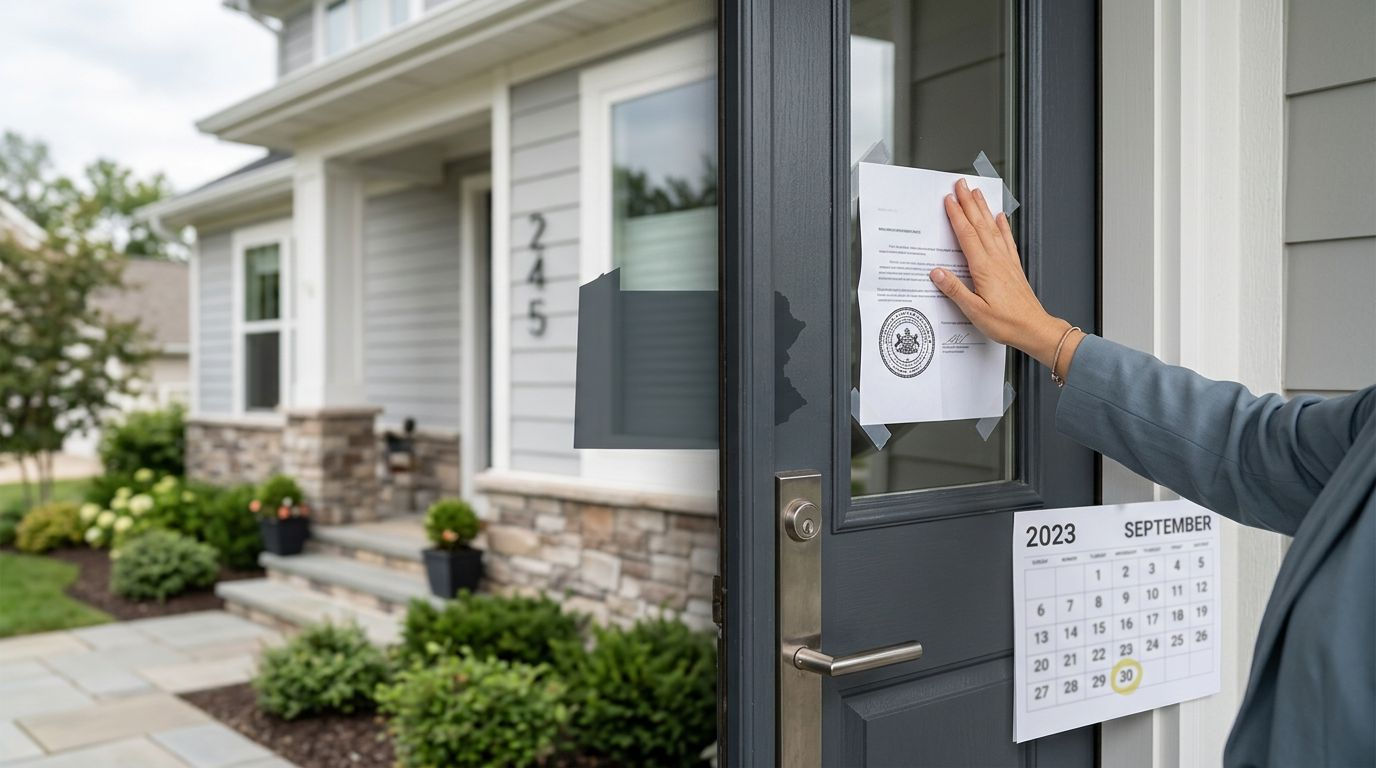
Service of notice matters almost as much as wording. Hand delivery or certified mail with proof of receipt is common, as is posting conspicuously on the principal building (usually the front door). The residential lease may add its own service terms. Landlords should prepare a Certificate of Service to prove delivery in court and save mailing receipts, photos, and written notes about the date and method of delivery. Tenants should keep the envelope and their copy for the same reason.
What Happens After the 30 Days End
If the tenant does not move out or cure a correctable violation within the deadline, the landlord still cannot remove the tenant alone. The next step is filing a Landlord/Tenant Complaint in the local Magisterial District Court.
At the hearing, overseen by the Magisterial District Judge, both sides can bring documents and witnesses. A landlord may bring the lease, the notice, payment records, photos, and messages. A tenant may raise defenses under the Landlord/Tenant Act, such as wrong notice length, bad service, payment, or facts that dispute the claimed breach of lease.
If the landlord wins, the court can issue a Judgment for Possession and, in some cases, a money judgment. After judgment, there is still a court-controlled wait before physical removal. That pause matters, because it gives the tenant a short window to move, pay in some cases, or appeal the decision when the law allows.
Even then, the landlord must follow the court's eviction process by obtaining an Order for Possession. The Order for Possession is served by a sheriff or constable to achieve recovery of possession. Changing the locks, shutting off utilities, or putting belongings on the curb without a court Order for Possession amounts to illegal eviction or self-help eviction, which can create serious trouble. For a step-by-step view of hearings, the Order for Possession, and possession overall, see the Pennsylvania eviction process guide.
Conclusion
The hardest part of a Pennsylvania eviction notice is not writing the paper. It's choosing the right notice period and proving that it was served the right way.
When the facts match the 30-day rule in the eviction process, a clear written 30-day notice puts the case on solid ground. When they don't, the filing can fall apart before the hearing even starts. Accuracy matters more than speed.
FAQs
Can a Landlord Use a 30-Day Notice for Unpaid Rent?
Usually no. In Pennsylvania, nonpayment of rent or rent in arrears cases often use a 10-day notice instead of 30. Landlords should also check the lease, because notice terms can change the analysis.
Does a 30-Day Notice Mean the Tenant Must Leave Without a Court Case?
No. The 30-Day Notice to Quit is just the first step in the Magisterial District Court process. If the tenant stays past the deadline, the landlord usually must file in court and win possession before a constable or sheriff can carry out the removal.
Can a Tenant Fix the Problem and Stay?
Sometimes. If the notice is based on a lease violation that can be corrected, fixing it within the deadline may stop the landlord's action for recovery of possession. If the landlord is ending the tenancy rather than offering a cure, the tenant may still have to move.
Can Text or Email Count as Notice?
That's risky unless the lease clearly allows it and the court will accept it. Paper notice with proof of delivery is safer, because it is easier for the sheriff or constable to verify service later at a hearing.


Comments