
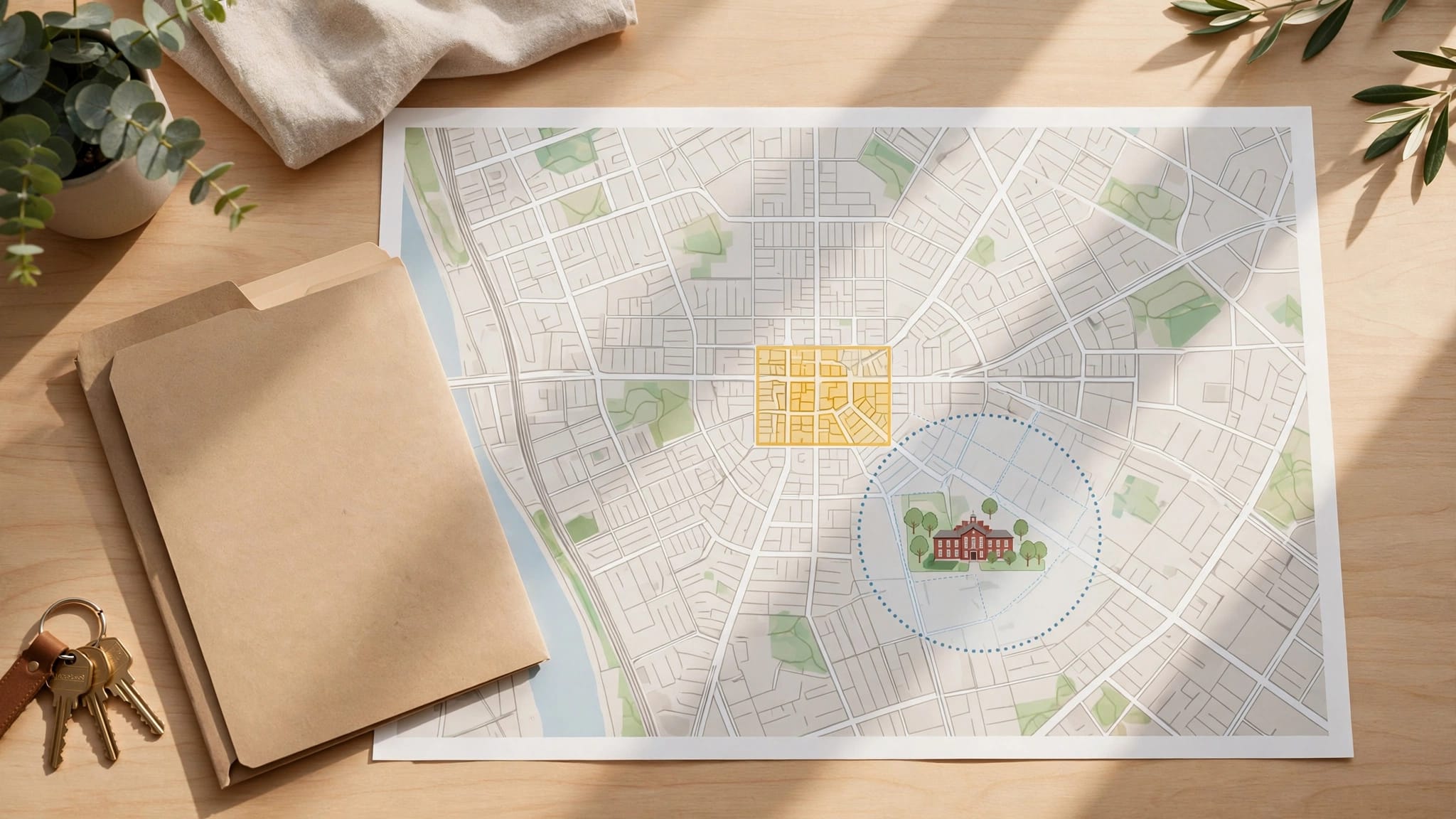
Find Your Philadelphia School Catchment Before Renting

To find your Philadelphia school catchment, enter a rental's full street address in the School District of Philadelphia's School Finder. Your child's assigned school depends on that address, not the neighborhood name in an apartment listing.
Make this lookup before signing a lease, especially if a particular school matters to your move. A nearby school isn't necessarily the assigned school, and a School Selection option isn't a guaranteed placement.
Start with the address, then separate neighborhood enrollment from applications for other schools.
Key Takeaways
Every student in kindergarten through grade 12 has an assigned school based on their home address.
You don't need a School Selection application to attend that school; enrollment is online or in person.
School Selection lets eligible students rank up to five alternatives, but admission isn't guaranteed.
For 2027-28, School Selection closes November 24, 2026, at 11:59 PM.
What a Philadelphia School Catchment Means
Catchment and Neighborhood School Mean the Same Thing
A catchment area is the geographic boundary for a catchment school, the public school assigned to an address. In Philadelphia, "catchment" and "school boundaries" describe the address-based areas that determine public school assignment.
The City of Philadelphia's guidance on finding your designated neighborhood school directs families to the School District of Philadelphia's address-based lookup. That's the starting point for identifying the school attached to a prospective rental.
Catchment assignment covers kindergarten through grade 12. Although many online maps focus on elementary schools, that narrower coverage doesn't mean neighborhood assignment stops after elementary school.
Grade Level Matters Alongside the Address
An elementary school map won't answer every enrollment question. Your child's entering grade matters because schools have different grade configurations.
High school assignment also involves feeder patterns. Catchment high schools have open admissions for students who completed eighth grade in the school's feeder pattern, based on their home address.
Therefore, identifying an elementary catchment alone doesn't establish the full school pathway. Keep your child's entering grade and intended school year attached to every address you research.
How to Find Your Philadelphia School Catchment
Enter the Full Rental Address
Open the District's School Finder and search using the rental's complete street address. Enter the building number and street name, not a neighborhood, intersection, or ZIP code.
Match the result to the actual building. Check the catchment map carefully if a boundary runs nearby, and confirm that the property falls within the catchment area shown. Don't use a leasing office address or the address of another building in the development.
For our residences at The Columbia, use 2709 Cecil B. Moore Avenue, Philadelphia, PA 19121 for an address-based search.
This tool checks address-based school assignment. Use the School Selection application portal to apply to other District schools. An application doesn't determine catchment assignment.
Match the Assignment to the Grade and School Year
Read the school information associated with the address and distinguish the assigned school from other nearby schools. A map can show several campuses without assigning your child to all of them.
Check that the school's grade configuration matches your child's entering grade. Record the assigned school, grade, and school year together.
If the result is unclear or the boundary is ambiguous, contact the School District of Philadelphia about the exact rental address. Do the same if the property address doesn't resolve reliably. Request an individualized review and confirm the assignment before signing.
Save a dated screenshot or note for each rental on your shortlist. Catchment boundaries, enrollment policies, and grade configurations can change by school year, so an older result isn't a permanent promise about future assignment.
Compare Rental Addresses, Not Neighborhood Labels
Philadelphia rewards block-level research. Two rentals can share a neighborhood label or ZIP code while having different assigned schools.
Run each complete address through the same lookup process. Don't assume the assignment carries over because another apartment is around the corner or advertised under the same neighborhood name.
Our Philadelphia neighborhood guide for renters can help you compare the surrounding area. However, neighborhood descriptions provide context, not school assignments.
Keep a simple comparison record with each address, its assigned school, the relevant grade, and your intended move-in date. Add the actual school route alongside rent and commute costs.
For example, consider street crossings, the school entrance, and how drop-off fits your work schedule. A short distance on a map doesn't describe the entire morning routine.
Also separate a school's assignment from its suitability for your child. Grade coverage, available programs, and the daily trip deserve their own attention.
A rental's address determines its assigned school. Interest in another school doesn't create an admission offer.
Neighborhood Enrollment vs. School Selection
Your Assigned School Doesn't Require School Selection
Families can attend their assigned school without submitting an application through the District's selection process. They enroll online or in person at that school.
The District's School Selection process is separate and lets students seek another District school with available space. Most participants are eighth graders exploring high school options, but students currently in PreK through grade 11 can participate.
Citywide high schools draw applicants from across Philadelphia rather than serving one neighborhood catchment. District magnet schools require the applicable School Selection process and eligibility, not an automatic catchment assignment. Charter and private schools have separate admissions.
This distinction matters during a rental search. A neighborhood school is tied to the home address; admission to another District school depends on the selection process. The District's Find Your Fit resource helps families explore options, but it doesn't guarantee placement.
Rank Up to Five Schools by True Preference
Through the District's School Selection process, families can rank up to five schools or programs in their preferred order.
The District uses Avela's Deferred Acceptance algorithm, a ranked-choice lottery. It connects the underlying research to Shapley and Roth, recognized with the 2012 Nobel Prize. The District describes the system as strategy-proof, so make your ranking reflect your true preferences rather than guessing which choice is easiest.
Applicants receive one offer or no offer during the initial phase. An offer doesn't mean several acceptances arrive for the family to compare afterward.
Students receiving an offer may remain waitlisted for eligible choices ranked above that offer. Students receiving no offer may be waitlisted for all their eligible choices.
How Eligibility and Preferences Affect Applications
Criteria-based schools evaluate eligibility before an application can compete for placement. The District uses ELA or Reading, Math, and Science grades; Social Studies and Writing are no longer included in those grade requirements. Families can use Find Your Fit to explore options, then check each school's current requirements.
Sibling preference applies when a student has a sibling enrolled in the requested catchment or citywide school. It doesn't apply to criteria-based schools. Therefore, an older child's enrollment doesn't create the same preference at every school.
For 2027-28, ZIP code preference covers 19132, 19133, 19135, 19138, 19140, and 19141 at Masterman, Central, Carver, and Palumbo.
That preference applies to specified eligible schools and entry grades. Living in one of those ZIP codes doesn't automatically establish eligibility or guarantee admission.
Keep these preferences separate from catchment assignment when comparing apartments. A ZIP code preference is part of a selection application, while the assigned school comes from the full home address. Neither sibling preference nor ZIP code preference should turn an uncertain application outcome into an assumed placement.
The 2027-28 School Selection Timeline
As of October 2026, applications for 2027-28 are open. The deadline is November 24, 2026, at 11:59 PM.
Confirm these dates against the District's current official school selection timeline before relying on them. Dates and notification windows can change.
The District publishes the following sequence and month-based windows for the process:
Stage | Published Timing |
|---|---|
Application deadline | November 24, 2026, at 11:59 PM |
Preliminary eligibility | December/January |
Offers and acceptances | February/March |
Waitlist offers | March/April |
The application deadline is precise; the later windows don't identify a single notification day.
For renters, the practical issue is timing. Your lease decision may arrive before an offer or waitlist result. Build your housing decision around the assigned school rather than treating an application as a confirmed alternative. Keep rental deadlines and school deadlines in separate calendar entries.
Frequently Asked Questions
Does Renting Change My Child's Catchment Assignment?
Assignment depends on your home address, not whether you own the property. Renting doesn't create a separate School Selection requirement for your assigned school. Use the address where your family will live, rather than an apartment search area.
Can My Child Attend a School Outside Our Catchment?
Yes. School Selection allows families to apply to other District schools, subject to eligibility and available space. You can rank up to five choices, but submitting an application doesn't guarantee an offer. Your rental search shouldn't assume that an application will succeed.
How Do We Enroll in Our Neighborhood School?
You can enroll online or in person at the assigned school without a School Selection application. The District's Student Enrollment and Placement resources provide the enrollment route. Looking up an address identifies the school; it doesn't complete enrollment.
Does a ZIP Code Identify Our Elementary School?
No. A ZIP code is too broad to establish a specific school assignment. Use the full street address in the District's School Finder. Also distinguish ZIP code preferences at certain criteria-based schools from the address-based assignment to your neighborhood elementary school.
Make the School Assignment Part of Your Lease Decision
Your Philadelphia school catchment belongs beside rent, layout, and commute on your apartment comparison sheet. Verify the exact rental address and confirm the assigned school for your child's grade and intended school year. Ask the District directly about any unclear result before signing.
Treat School Selection as a separate application process with uncertain outcomes. Before committing to a rental, make sure your decision works with the assigned school, even if another application doesn't produce an offer.


Comments