
Philadelphia Apartment Accessibility: A Renter's Checklist

An elevator, step-free entrances, or a ground-floor listing doesn't automatically make an apartment workable for your needs. Philadelphia apartment accessibility depends on the full route you use every day, from the sidewalk and building entry to the bathroom, kitchen, and package room.
A careful tour can save you from signing a lease for a place that looks promising but has one barrier that affects daily life. Use this checklist to compare apartments, ask the leasing team targeted questions, and put needed changes in writing.
Key Takeaways
Treat "wheelchair accessible" as a starting point. Check the route, doorway widths, bathroom layout, and common spaces during your tour.
The Fair Housing Act sets seven design standards for many newer multifamily buildings. The Americans with Disabilities Act often applies to public-facing areas.
Ask the leasing team for a reasonable accommodation or modification in writing before signing a lease. This is especially important for reserved parking, an assistance animal, or a physical change.
Philadelphia's affordable housing options may include fully accessible units and sensory units. Income rules, referrals, and waiting lists may apply.
An apartment can have an elevator and still be difficult to use if the entry, unit door, bathroom, or route to daily amenities creates a barrier.
Philadelphia Apartment Accessibility Checklist for Tours
Start your tour at building entrances. Even fully accessible units, including designated units, need an in-person inspection, since a curb, heavy door, or narrow hallway can make a home impractical.
Check the Entry and Common Areas First
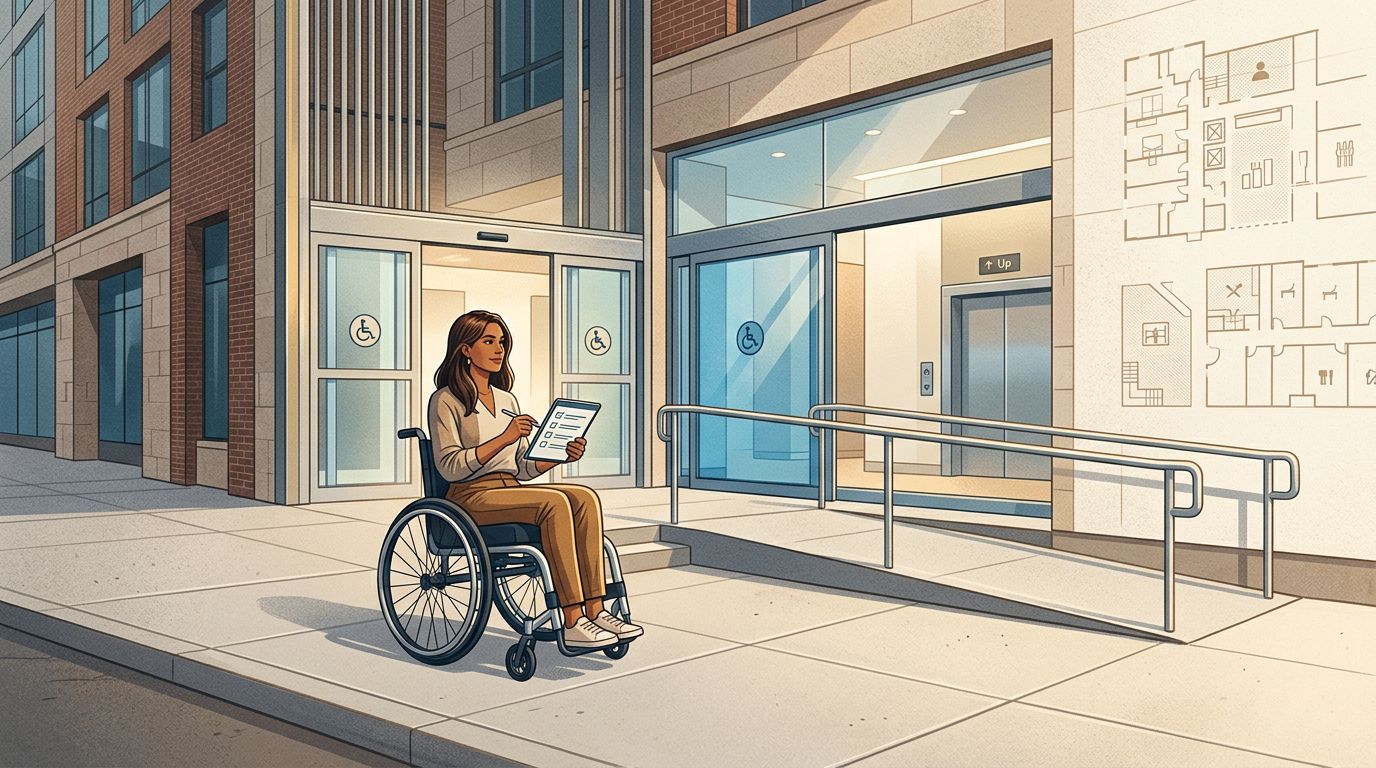
Look for step-free entrances and a continuous route from parking, a sidewalk, or a public transportation drop-off to the unit. A ramp should have a stable surface, manageable slope, handrails where needed, and a landing at the door.
Test the main door if you can. Ask the leasing team who can explain the building route and whether the door has power assistance, keyless entry, or a pull you can operate comfortably. Then follow the same path you would use for mail, trash, laundry, packages, and community amenities such as fitness spaces.
In buildings with an elevator, check the cab size, button height, door timing, and whether it reaches every amenity you plan to use. If you drive, ask about parking reserved for access needs, curb cuts, lighting, and the distance from the space to the entrance.
Confirm the Actual Unit, Not the Model
Ask the leasing team to show you the exact floor plan you would lease. A staged model can hide tight turns, a raised shower threshold, or an obstructed route around kitchen islands and furniture.
Within the unit, notice whether you can move from the entry to the bedroom, bathroom, kitchen, closets, and windows without a sharp turn. Doorways need more than a wide-looking opening. You need enough approach space to open the door and pass through it safely.
For accessibility in Philadelphia apartments, bring a tape measure if you have a mobility impairment or use a mobility device. Also ask whether door hardware, closet rods, thermostat controls, and intercoms are within your reach range.
Look Closely at Kitchen, Bathroom, and Sensory Features
Accessibility features should support ordinary routines, not only entry into the apartment. Focus on the spaces you will use several times each day.
In the kitchen, check knee clearance under work surfaces, reachable storage, appliance controls, and turning space near the refrigerator and stove. Lowered counters can help some renters, while others may need movable shelving or a different cabinet layout.
Bathroom details often determine whether fully accessible units meet your needs with a mobility impairment. Look for roll-in showers or a low-threshold shower, enough room beside the toilet, a reachable sink, and sturdy grab bars. If grab bars are not installed, ask whether the bathroom walls are reinforced for them.
Renters with a sensory impairment should also ask about visual fire alarms, doorbell alerts, tactile signage, lighting controls, and communication options with management. Features described as "available upon request" may require advance approval and installation time.
Senior communities, including properties such as The York House, may offer bathroom supports, accessible vertical circulation, or adaptable layouts. Still, confirm with the leasing team what comes standard in the exact unit and what requires a separate request.
Know What the Fair Housing Act and ADA Cover
The federal housing statute and the Americans with Disabilities Act both address disability access, but they apply differently. The federal housing statute covers most residential rentals and prohibits housing discrimination. The ADA usually applies to public accommodations and commercial spaces, such as a leasing office or retail space in a mixed-use building.
For covered multifamily properties with four or more units first occupied after March 13, 1991, the federal design standards include seven design and construction requirements:
Design Standard | What It Means During a Tour |
|---|---|
Accessible building entrances | At least one entrance connects to an accessible route. |
Accessible common areas | Shared spaces should be usable by people with disabilities. |
Usable doors | Doors must allow a wheelchair to pass through. |
Route through the unit | The path into and within the unit needs to be accessible. |
Reachable controls | Switches, outlets, thermostats, and similar controls must be reachable. |
Reinforced bathroom walls | Walls should support future grab-bar installation. |
Usable kitchens and bathrooms | The layout must allow wheelchair maneuvering. |
Older buildings may not meet these design and construction requirements. However, landlords may still need to consider a reasonable accommodation, such as a reserved parking space or an exception to a no-pet policy for an assistance animal. During a tour, verify step-free entrances and ask the leasing team who handles accommodation requests.
A reasonable modification is a physical change, such as adding a ramp or grab bars. For a reasonable accommodation or modification request, copy the accessibility coordinator on a written request and save management's response. The accessibility coordinator can help route or track the request. The Urban League of Philadelphia's housing accessibility overview offers added context on accessible housing and modification resources.
Find Accessible and Affordable Housing in Philadelphia
Availability changes quickly, so search tools are more useful than a static list of buildings. The City of Philadelphia directs renters to accessible housing resources and Home Finder, which includes affordable housing listings and disability-related housing support.
The Philadelphia Housing Authority (PHA) offers units for renters with mobility, hearing, and vision impairments. Renters with a sensory impairment may need sensory units or communication support. Its accessible housing program also explains how to request communication assistance or other accommodations.
PHA lists Scott Westfall as its 504 accessibility coordinator. That accessibility coordinator can help with admissions materials or an interview. To request a reasonable accommodation, call 215-684-4453 and ask for one. Applicants may submit an accommodation form to the Admissions Office, a property manager, or the accessibility coordinator. State on the form that you are requesting a reasonable accommodation and explain the support needed. Ask the accessibility coordinator which submission route applies.
Affordable housing developments can have fully accessible units, although each program has its own eligibility and vacancy rules. Ask the leasing team about units at Good Shepherd Senior Residences, Abigail Pankey Apartments, Mamie Nichols Townhomes, and NC Five Apartments. Confirm availability, features, building entrances, income limits, eligibility rules, and next steps in the application process. Don't assume a listing is current.
For income-restricted housing, ask which Area Median Income threshold applies to the program. HUD generally defines "very low income" as household income at or below 50% of Area Median Income, adjusted for household size. Programs may use stricter limits. Prepare a photo ID, income records, benefit letters, bank statements, tax returns, asset information, and documents for each household member.
Old First House includes accessible and sensory units. Renters experiencing homelessness should ask the City's Office of Homeless Services about the current referral process for those apartments.
Put Accessibility Requests and Unit Condition in Writing
Before you apply, email the property manager a short list of the features that matter most. Document any reasonable accommodation request in that message. Ask whether the features are present in the available unit, whether any modification needs approval, who will pay, and when the work will be complete.
Keep the listing, floor plan, emails, reasonable accommodation request, approvals, and written promises in one folder. If the building identifies an accessibility coordinator, copy that person on relevant messages. At move-in, take dated photos of ramps, thresholds, bathroom fixtures, appliances, and existing damage. Clear records make repair requests easier to track and help prevent disputes over what the apartment offered.
If an accessibility feature breaks or a safety issue goes unanswered, report it through the building's stated maintenance channel. For serious housing concerns, Philadelphia renters can also use Philadelphia 311's special-needs housing information to find the appropriate contact.
Conclusion
A successful apartment search starts with the route you will use every day, not a broad accessibility label. Check the entry, unit layout, bathroom, kitchen, common spaces, and communication features before you commit.
Written requests and careful records turn a vague accessibility label into clear expectations for your home.
FAQs
What Are the Seven Fair Housing Act Design Requirements?
They cover an accessible entrance, accessible common areas, usable doors, an accessible route through the unit, reachable controls, reinforced bathroom walls, and usable kitchens and bathrooms. These standards apply to many covered multifamily properties built for first occupancy after March 13, 1991.
How Do I Request a Reasonable Accommodation From PHA?
Contact PHA and explain the accommodation you need because of a disability. Submit the request through the Admissions Office, a property manager, or PHA's Accessibility Coordinator. Keep a copy of the form and the accessibility coordinator's response.
What Documents Do Accessible Affordable Housing Applications Require?
Most applications ask for identification, household details, income verification, benefit letters, bank statements, tax records, and asset information. Gather documents early because missing paperwork can delay an application or lottery review.
Which Philadelphia Apartments Offer Fully Accessible Units?
Properties with accessible units can include Good Shepherd Senior Residences, Abigail Pankey Apartments, Mamie Nichols Townhomes, and NC Five Apartments. Call each leasing office to confirm current availability, unit features, income restrictions, and application steps.
Who Refers Homeless Renters to Old First House?
The City's Office of Homeless Services handles referrals for homeless individuals seeking the accessible and sensory units at Old First House. Ask about current eligibility rules and the referral path before applying.


Please get back with me ASAP
Hey there my name is Sharif Harris I've been in a wheelchair for three years now and I need help finding a place please tell me you can help me